
By IT Defined Team | April 22, 2026
Choosing between EKS, ECS, and Fargate for an Indian startup? Real cost comparison in INR, ap-south-1 pricing, and which one most Bangalore companies actually use.
Decision matrix at the top, because that's why you came
If you have less than 6 months runway and need to ship fast: ECS with Fargate. Lowest operational overhead, no Kubernetes complexity, ship in days.
If you're a product startup planning to scale to 50+ engineers: EKS. The Kubernetes ecosystem will pay off, even though it's painful for the first 6 months.
If your workload is bursty, batch-like, or you have just a handful of services: Fargate (under either ECS or EKS). Pay for what you use, no node management.
If your team has strong Kubernetes experience already: EKS, full stop. Don't fight the team's strengths.
Now the long version, with INR numbers.
What these things actually are
Quick refresher because I've seen confusion. ECS, EKS, and Fargate aren't three competitors at the same level. The relationship is more nuanced.
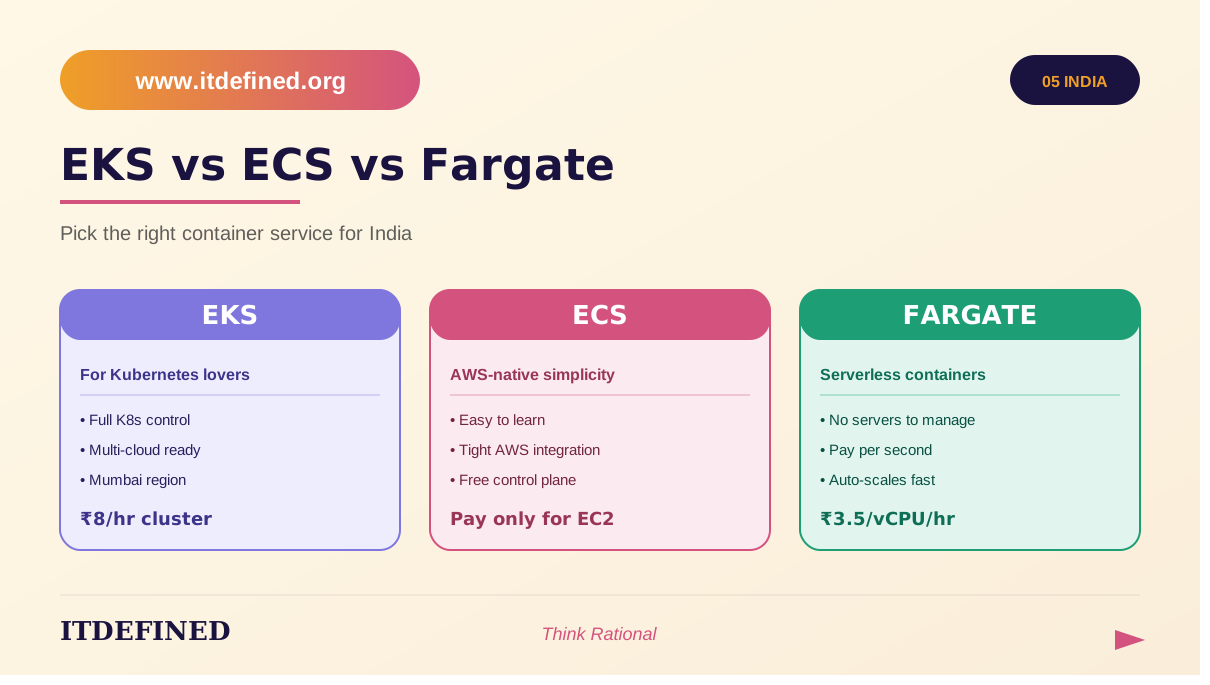
ECS is AWS's container orchestrator. AWS-native, simpler than Kubernetes.
EKS is AWS's managed Kubernetes service. Standard upstream Kubernetes, AWS handles the control plane.
Fargate is a serverless compute engine. It runs containers without you managing EC2 instances. You can use Fargate WITH ECS or EKS — it's not a separate orchestrator.
So your real choices are: ECS on EC2, ECS on Fargate, EKS on EC2 (managed node groups), or EKS on Fargate. Four options, four cost profiles.
Cost comparison in INR — running a 5-service app in ap-south-1
Let me make this concrete. Say you have a typical web app: API service, worker service, scheduler, admin panel, websocket service. Each runs 2 replicas of a small container (0.5 vCPU, 1GB memory). Total 10 containers, running 24/7.EKS on managed node groups (3x t3.medium): EKS control plane is $73/month (~Rs 6,100). Three t3.medium On-Demand in ap-south-1 are about $70/month each (~Rs 5,800), so $210 total (~Rs 17,500). Plus EBS, NAT Gateway, ELB. Total all-in: Rs 30,000-35,000/month.
EKS on Fargate: EKS control plane $73 (Rs 6,100). Fargate compute for 10 containers at 0.5 vCPU/1GB each, 24/7 = roughly $200 (Rs 16,500). Total: Rs 25,000-28,000/month.
ECS on EC2 (3x t3.medium): No control plane fee. Just the EC2 cost — $210 (Rs 17,500). Plus EBS, ELB. Total: Rs 22,000-25,000/month.
ECS on Fargate: No control plane fee. Just Fargate compute — $200 (Rs 16,500). Plus ELB. Total: Rs 20,000-22,000/month.
ECS on Fargate is the cheapest for small workloads. EKS is roughly Rs 6,000-8,000/month more expensive at small scale because of the control plane fee. As you scale up, this difference matters less proportionally.
These are list prices. With Savings Plans or RIs you can knock 30-40% off the EC2 portion. Fargate has Savings Plans too (up to ~50% off).
Operational overhead — the hidden cost
Cost in INR is only half the story. The bigger hidden cost is engineering time.
EKS, even managed EKS, requires real Kubernetes expertise. You need someone on the team who can debug a failing pod, write Helm charts, manage RBAC, configure ingress, handle upgrades (every 4 months on average). Realistically, this is 30-50% of one DevOps engineer's time at small companies. That engineer in Bangalore is 18-30 LPA. Real cost: Rs 5-12 lakhs annually in engineering time.
ECS is dramatically simpler. Task definitions are JSON, not Helm charts. AWS handles most of the operational stuff. Most Indian startups I see can run ECS workloads with maybe 10-15% of one engineer's time. Maybe Rs 2-3 lakhs/year in engineering time.
Fargate (under either) removes node management. You don't worry about node sizing, AMI updates, autoscaler tuning. This is huge for small teams.
When you add up engineering time, the pure-cost picture shifts. ECS on Fargate often wins for startups under 30 engineers. Once you're past that scale, EKS's ecosystem advantages start to matter more.
Why most Bangalore startups pick EKS anyway
Despite ECS being objectively simpler, I see most product startups in Whitefield and Marathahalli reaching for EKS. Why?
First, hiring. The Kubernetes talent pool is huge. Hiring a DevOps engineer with EKS experience is straightforward. Hiring one with deep ECS experience is harder — it's a smaller community.
Second, ecosystem. ArgoCD, Helm, Istio, Karpenter, Prometheus, the whole CNCF universe — these all run on Kubernetes. ECS doesn't have most of this. If you want progressive delivery, service mesh, or sophisticated autoscaling, you're more likely to need EKS.
Third, multi-cloud optionality. Even if you're AWS-only today, EKS gives you a path to Azure or GCP later by running upstream Kubernetes. ECS locks you into AWS forever.
Fourth, vendor and partner integrations. Most modern observability vendors (Datadog, New Relic, Grafana Cloud) ship Kubernetes integrations first, ECS integrations second.
Fifth — and people don't say this out loud — Kubernetes is what the resume requires. Engineers want EKS experience because their next job will require it.
Where ECS still wins decisively
I don't want to be unfair to ECS. There are real cases where it's the right call:
- Small teams (under 10 engineers) running simple containerized apps
- Heavy AWS-native shops where you use Lambda, Step Functions, EventBridge as your primary architecture, with containers as just a piece
- Workloads that fit ECS's pattern naturally — web services with simple scaling, batch jobs
- Companies that explicitly don't want Kubernetes complexity
If you're at a fintech or healthtech startup with a small team and you don't have full-time DevOps, ECS Fargate is genuinely a better choice than EKS. Don't let resume-driven development pressure you into Kubernetes you don't need.
When to use Fargate (under either)
Fargate makes sense when:
- Your workload is bursty — handles 10x traffic for 2 hours a day, idle the rest
- You want zero node management
- Your containers don't need GPU, special instance types, or Spot pricing
- Cost predictability matters more than absolute lowest cost
Fargate doesn't make sense when:
- You run heavy steady-state workloads where reserved EC2 is cheaper
- You need GPUs (Fargate has no GPU option)
- You need very high pod density per node
- You want Spot pricing (Fargate Spot exists but is more limited than EC2 Spot)
What we recommend at IT Defined
We teach EKS as the primary platform in our AWS DevOps program because that's what the job market wants. We cover ECS in enough depth that students can work with it in production codebases and answer interview questions.
But we're honest with our students about the tradeoffs. The course capstone deploys to EKS, but we discuss when ECS would have been the better choice.
Frequently asked questions
Is EKS Anywhere worth learning?
Only if you're at a company doing hybrid cloud or edge deployments. Niche.
What about Karpenter?
Karpenter is AWS's autoscaler for EKS, generally better than the cluster-autoscaler. If you're on EKS, learn Karpenter — it's becoming the default.
Should I use EKS Hybrid Nodes?
If you have on-premises workloads that need to integrate with EKS, yes. AWS announced the EKS Hybrid Nodes gateway in April 2026 which made this much easier. For pure-cloud setups, you don't need it.
Is Kubernetes overkill for my 5-person startup?
Honestly? Probably yes. ECS Fargate is fine until you're past 20 engineers or have specific needs Kubernetes solves. The pressure to use Kubernetes early is real but not always rational.
About IT Defined
IT Defined is a software training institute in Whitefield, Bangalore, offering hands-on programs in AWS DevOps, Full-Stack MERN, Python, and Cybersecurity. We've trained over 2,000 students with live projects, mock interviews, and placement support.
Visit: itdefined.org | Phone: +91 6363730986 | Email: info@itdefined.org