
By IT Defined Team | April 28, 2026
An honest comparison of Terraform and CloudFormation in 2026, with code examples, real cost differences, and which one wins for jobs in Bangalore.
The short answer (because I know you're scrolling)
Learn Terraform. If you're a beginner picking your first IaC tool in 2026, learn Terraform. CloudFormation is fine, it's not bad, but the job market and the ecosystem have decided. Terraform won.
Now, if you're already at a company using CloudFormation, you don't need to migrate. Stay where you are. Both tools do the same job, just differently.
The rest of this post is the long version with the receipts. Code examples, state management, modules, real interview questions, and one section on multi-cloud that I think most articles get wrong.
What we're actually comparing
Both Terraform and CloudFormation are infrastructure-as-code tools. You write declarative configuration that describes what you want, the tool figures out what API calls to make to AWS, and your infrastructure shows up. That's the basic deal.
The differences are in syntax, state management, ecosystem, multi-cloud support, error handling, and — this is underrated — what it feels like to debug them at 2am during an outage.
Syntax — HCL vs JSON/YAML
Here's a Terraform resource for an S3 bucket:
resource "aws_s3_bucket" "logs" {
bucket = "my-app-logs"
tags = {
Environment = "prod"
Owner = "devops-team"
}
}
Here's the same thing in CloudFormation YAML:
Resources:
LogsBucket:
Type: AWS::S3::Bucket
Properties:
BucketName: my-app-logs
Tags:
- Key: Environment
Value: prod
- Key: Owner
Value: devops-team
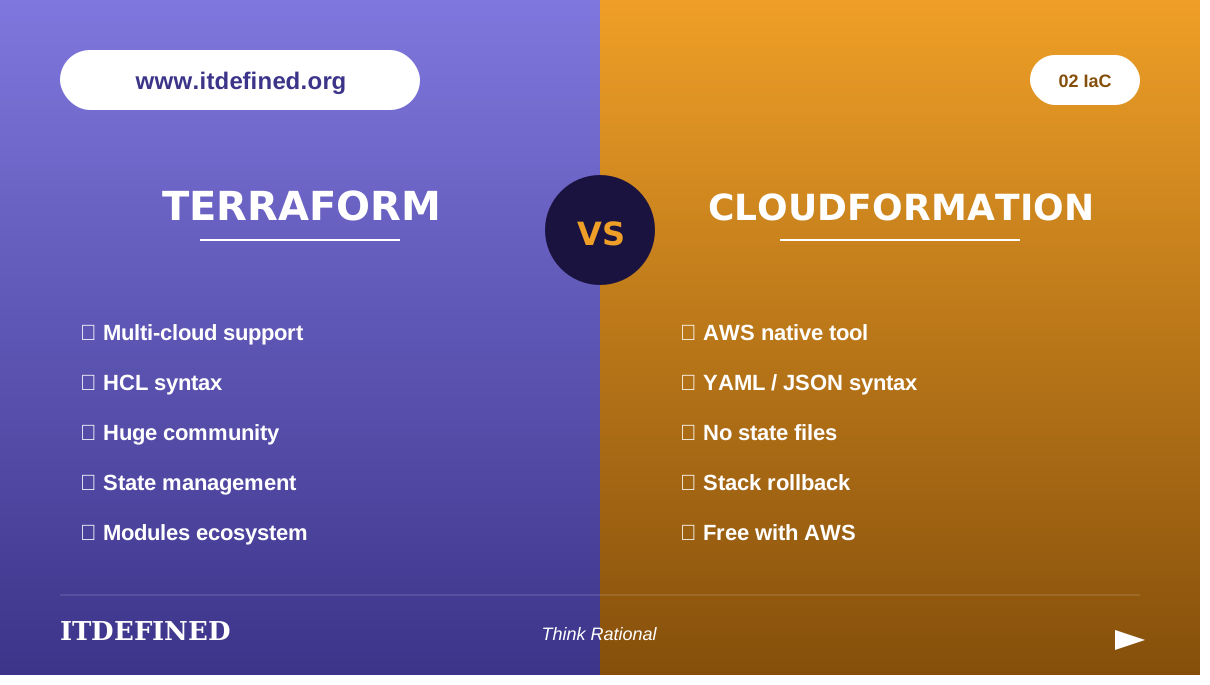
Both are fine. HCL is friendlier to read once you're used to it, but YAML is more universal — you already know it from Kubernetes manifests.
CloudFormation also supports JSON, but please don't use JSON for CloudFormation. Trailing commas, no comments, every developer who maintains it will hate you.
State management — this is where Terraform gets tricky
CloudFormation manages state for you. AWS knows what it created, AWS tracks it. There's no "state file." If you delete a stack, AWS deletes the resources. Simple.
Terraform keeps a state file. By default, it's a local JSON file called terraform.tfstate. In production, you put it in S3 with state locking via DynamoDB. If you lose this file, Terraform forgets your infrastructure exists, even though AWS still has the resources.This sounds bad. It is bad, the first time you mess it up. But there's a tradeoff — Terraform's state model is what makes it portable across clouds. AWS doesn't manage your Azure resources, so for multi-cloud setups, Terraform's approach is the only option.
Practical advice: if you go with Terraform, set up remote state in S3 with DynamoDB locking from day one. Never use local state for anything beyond personal experiments.
Modules and reusability
Terraform modules are first-class. There's a public registry with thousands of community modules. Need a VPC? Don't write it yourself. Use the terraform-aws-modules/vpc module. It's battle-tested, handles edge cases you haven't thought of yet.CloudFormation has nested stacks and custom resources. They work. They're more verbose. The community ecosystem is much smaller because most people who care enough to publish reusable IaC modules use Terraform.
AWS CDK (which generates CloudFormation under the hood) does have a healthier ecosystem. If you're a developer who likes writing TypeScript or Python more than HCL, CDK is genuinely good. But it's still niche compared to Terraform.Multi-cloud — the most misunderstood argument
People say "learn Terraform because it's multi-cloud." Then they only ever use it for AWS.
Real talk: most Bangalore companies are AWS-only. Or AWS plus a tiny bit of GCP for BigQuery. The multi-cloud dream is real for a small number of large enterprises, mostly outside India.
But here's the thing — even if you're AWS-only, Terraform's provider model means you can also manage GitHub repos, Cloudflare DNS, Datadog dashboards, PagerDuty schedules, and a hundred other things in the same codebase as your AWS infrastructure. CloudFormation can't do that. That's the actual advantage in practice — not multi-cloud, but multi-vendor.
Drift detection and updates
If someone goes into the AWS Console and manually changes a security group that Terraform created, what happens?
Terraform: next plan/apply detects the drift and offers to revert it. Clean.
CloudFormation: drift detection exists but has to be triggered manually via stack drift detection. Less elegant. AWS has been improving this, and config-drift detection in 2026 is much better than it was in 2022, but Terraform's plan workflow is still smoother.
Error messages and debugging
Terraform errors are usually clear. "Resource X failed because Y." The provider tells you which API call failed and why.CloudFormation errors are sometimes clear, sometimes... not. "Stack rollback in progress" with a vague reason buried in events. You'll spend more time digging through stack events to find the actual failure. This has improved over the years but it's still the more painful debugging experience.
Cost — running both at scale
Both are free to use. Terraform Cloud has paid tiers for teams (state hosting, run pipelines, policy enforcement) but you can avoid those by hosting state in S3 yourself. CloudFormation is just free.
If you use Terraform Cloud for a 10-person team, expect roughly $20-70 per user per month depending on tier. Most teams skip it and just use CI/CD pipelines instead. We do.
What the job market actually says
I run a training institute, so I track what JD requirements look like. As of early 2026, looking at LinkedIn and Naukri postings for Bangalore DevOps roles:
- Terraform mentioned: roughly 75-80% of postings
- CloudFormation mentioned: roughly 30-35%
- Pulumi or CDK mentioned: less than 5%
Most jobs that mention CloudFormation also mention Terraform. Few jobs require only CloudFormation. So Terraform-first is the safer bet for hireability.
When CloudFormation actually wins
I don't want to be unfair. There are real cases where CloudFormation is better:
- Pure AWS shops with strong AWS Organizations/Control Tower setups — Service Catalog and CloudFormation StackSets integrate beautifully
- Compliance-heavy environments where you want AWS-native audit trails on everything
- Teams already invested in AWS CDK — the developer experience there is excellent
- Lambda-heavy serverless apps — SAM (which generates CloudFormation) is genuinely simpler than equivalent Terraform for serverless
If your company is in one of these buckets, don't fight it.
Common interview questions on both
These come up a lot. If you're job hunting:
- What's the difference between terraform plan and terraform apply?
- How do you manage Terraform state in a team setting?
- What happens if two engineers run terraform apply at the same time?
- How do you import an existing AWS resource into Terraform?
- What's the difference between count and for_each?
- When would you use a CloudFormation custom resource?
- What's the difference between CloudFormation parameters, mappings, and conditions?
- How do you handle secrets in IaC? (Hint: not in your repo. Use SSM Parameter Store or Secrets Manager and reference them.)
What we teach at IT Defined
Honestly? We teach both, but we go deeper on Terraform. Roughly 70/30 split. Students build their AWS DevOps capstone project in Terraform, and we cover CloudFormation in enough depth that they can read it in production codebases and answer interview questions.
If you're starting out and only have time for one — go Terraform. If you want to be the most hireable DevOps engineer you can be, learn Terraform deeply, then learn enough CloudFormation to be conversational about it. That's the path.
Frequently asked questions
Is AWS CDK better than Terraform?
It depends. CDK is great if your team is strong in TypeScript or Python and you want IaC that feels like writing code. It generates CloudFormation behind the scenes. Terraform is more universal and has more community support. Neither is objectively better — pick based on team skills.
Can I use both Terraform and CloudFormation in the same project?
Yes, and large companies do. Common pattern: CloudFormation for AWS-native stuff (Service Catalog products, baseline accounts), Terraform for everything else.
What about Pulumi?
Pulumi lets you write IaC in real programming languages — Python, TypeScript, Go. It's growing but still niche. Don't make it your first IaC tool unless your company already uses it.
Should I learn Terragrunt?
Only after you're comfortable with Terraform. Terragrunt is a wrapper that handles multi-environment, multi-region setups. Useful at scale, overkill for beginners.
About IT Defined
IT Defined is a software training institute in Whitefield, Bangalore, offering hands-on programs in AWS DevOps, Full-Stack MERN, Python, and Cybersecurity. We've trained over 2,000 students with live projects, mock interviews, and placement support.
Visit: itdefined.org | Phone: +91 6363730986 | Email: info@itdefined.org