
By IT Defined Team | April 30, 2026
A realistic 6-month AWS DevOps roadmap for 2026 — what to learn each month, what to skip, and how to actually land a DevOps job in Bangalore.
Why I'm writing this in 2026 (and not just reposting 2023's roadmap)
Most AWS DevOps roadmaps you'll find on Google are stale. They were written in 2022 or 2023, copied to Medium ten times, and the only update has been the title — "2024 edition," "2025 edition," same content. I've trained over 2000 students at IT Defined here in Bangalore, placed people at NTT DATA, VECV, smaller startups in Whitefield, and the truth is: the path that worked in 2023 is not the path that works now.
AI changed things. Recruiters changed things. Even AWS itself changed things — they launched DevOps Agent in April this year, and the entire conversation about what a DevOps engineer does is shifting under our feet.
So this is what I'd actually tell a student walking in tomorrow morning, asking "what do I learn, in what order, to be hireable in 6 months?" No fluff. Some of this will be uncomfortable.
First, the honest part: who is this for?
If you're a fresher with a CS or IT degree and 0 to 2 years experience, this works. If you're a manual tester, support engineer, or sysadmin trying to switch — this works, maybe better, because you already know production pain.
If you're a developer with 5+ years and you want to add DevOps as a second skill, you can compress this to 3 months. You already know Linux, Git, and probably some scripting. Skip the basics.
If you've never used a terminal in your life, add a month at the front for Linux fundamentals. Don't try to skip it. I see this fail every batch.
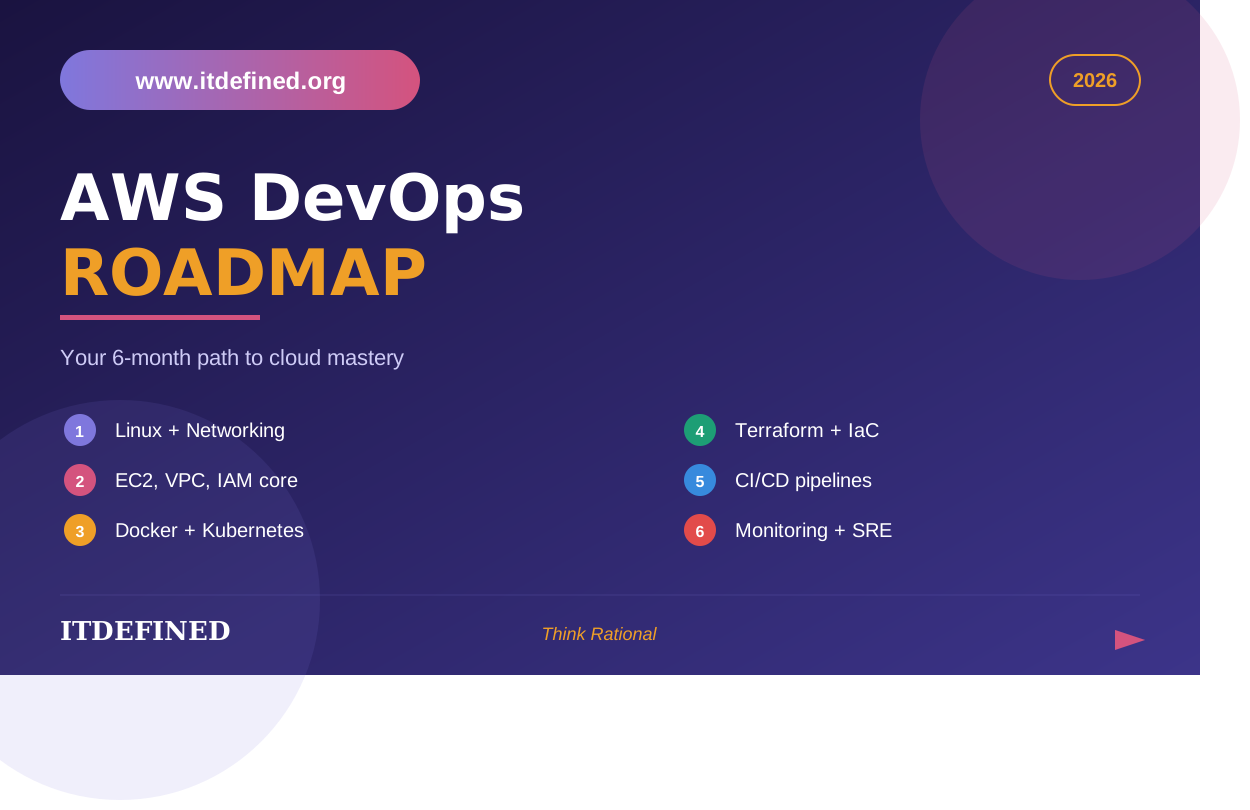
Month 1: Linux, networking, Git — the unsexy foundation
Nobody wants to spend a month on this. Everyone wants to jump to Kubernetes on day one. Don't.
Here's what you actually need:
- Linux command line — file system, permissions, processes, systemd basics, package management. Not memorizing 200 commands. Knowing which 30 you'll use every day.
- Bash scripting — variables, loops, conditionals, writing a script that takes arguments and exits with proper codes. If you can write a script that backs up a directory to S3 and emails on failure, you're done.
- Networking — TCP/IP, ports, DNS, HTTP/HTTPS, what a load balancer does, what a reverse proxy does, what a CIDR block is. Do not skip CIDR. Every AWS interview has CIDR questions.
- Git — branching, merging, rebasing, resolving conflicts, and the one most people skip: knowing how to recover from `git reset --hard` mistakes.
Time spent: 4 weeks, about 2 hours a day. If you've done a CS degree, you can compress to 2 weeks but actually do the labs — don't just watch videos.
Month 2: AWS core services
Now AWS. But not the way most courses teach it — "here are 200 services, let me give you a 5 minute overview of each." That's useless. You'll forget everything by next month.
What matters in month 2 is the 12 services you'll touch every day in DevOps work:
- EC2 — instances, AMIs, security groups, key pairs, instance types, EBS volumes. Spin up an instance from scratch using only the CLI.
- VPC — subnets, route tables, internet gateways, NAT gateways, peering. Build a 3-tier VPC manually. This is where most freshers fall apart in interviews.
- IAM — users, groups, roles, policies, trust relationships. Learn least privilege from day one. AWS will expect you to write a policy that gives EC2 read-only access to one S3 bucket without help.
- S3 — buckets, versioning, lifecycle rules, presigned URLs, bucket policies vs IAM policies (yes there's a difference and it confuses everyone).
- RDS — basics. Don't go deep, just understand what a managed database is and why you'd use it over running MySQL on EC2.
- CloudWatch — metrics, logs, alarms. Set up an alarm that emails you when EC2 CPU goes above 80%.
- Lambda — basics of serverless. Write one function that processes an S3 upload.
- Route 53 — DNS, hosted zones, record types.
- ELB — ALB vs NLB, target groups, health checks.
- ECR — container registry. You'll use this in month 4.
- Systems Manager — Parameter Store, Session Manager. Stop using SSH. Use SSM.
- Cost Explorer — yes, learn this in month 2. Half the DevOps job is making sure you don't blow up the bill.
Get the AWS Solutions Architect Associate cert at the end of this month. Or right after. It's not strictly required for DevOps roles but recruiters in Bangalore filter resumes on it. Don't fight that.
Month 3: Infrastructure as Code (Terraform first, then a peek at CloudFormation)
I'm going to be opinionated here. Learn Terraform. Not CloudFormation. Yes, CloudFormation is AWS-native. Yes, it integrates better with some AWS services. But the job market in Bangalore is 80% Terraform shops and that ratio is growing.
What you need to actually master:
- HCL syntax, providers, resources, data sources
- Variables, outputs, locals — the basics of making your code reusable
- Modules — building your own, using community ones from the registry
- State — local state, remote state in S3, state locking with DynamoDB. Run a `terraform import` at least once on an existing resource.
- Workspaces — for managing dev/staging/prod from one codebase
- Common patterns — VPC module, EKS module, RDS module
Build something real this month. My students build a 3-tier web app infrastructure: VPC, ALB, EC2 auto-scaling group, RDS, S3, all in Terraform, all version-controlled. That single project gets more interview callbacks than any cert.
Spend a week on CloudFormation just so you can answer "why did you pick Terraform?" in an interview. The answer is multi-cloud, larger community, better module ecosystem. Don't be dogmatic about it though.
Month 4: Containers — Docker, then Kubernetes
Two weeks Docker. Two weeks Kubernetes. Tight schedule but doable.
Docker priorities:- Writing a production-grade Dockerfile — multi-stage builds, non-root user, minimal base images (alpine, distroless), .dockerignore, proper layer caching
- Docker Compose for local development
- Pushing to ECR with proper tagging strategies (git SHA based, not :latest)
- Understanding container internals — namespaces, cgroups, what makes a container different from a VM. You will be asked this.
Kubernetes priorities. This is where students get overwhelmed because there's so much to learn:
- Pods, ReplicaSets, Deployments, Services, Ingress — the basics, but really understand them
- ConfigMaps and Secrets
- Namespaces and RBAC
- Helm — chart structure, values files, templating
- EKS specifically — managed node groups, Fargate profiles, IAM Roles for Service Accounts (IRSA), the AWS Load Balancer Controller, EBS CSI driver
- Troubleshooting — and this is the underrated skill. CrashLoopBackOff, ImagePullBackOff, pending pods, OOMKilled, DNS issues. We have a 26-lab troubleshooting set we run our students through. If you can debug, you're worth your weight in gold.
Real talk: nobody learns Kubernetes in 2 weeks. You'll learn enough to be dangerous. Real proficiency takes 6 to 12 months of using it on actual workloads. That's fine. Get to dangerous in this month, refine on the job.
Month 5: CI/CD, observability, security
This is where it all comes together.
CI/CD — build a real pipeline. GitHub Actions is the most common in Bangalore right now (Jenkins is still around but losing share fast). Build this:
- Code push → run tests → build Docker image → push to ECR → deploy to EKS via Helm or ArgoCD → run smoke tests → notify Slack
Make sure you use OIDC federation for AWS auth from GitHub Actions, not access keys. Interviewers love this question.
Add ArgoCD if you have time — GitOps is the trend. Push-based deploys are dying.
Observability — Prometheus, Grafana, the basics. Set up monitoring on your EKS cluster from month 4. Add CloudWatch Container Insights so you can compare. Learn what RED metrics are (Rate, Errors, Duration) and what USE metrics are (Utilization, Saturation, Errors). These come up in interviews more often than you'd think.
DevSecOps — Trivy for image scanning, Checkov for IaC scanning, integrate both into your pipeline. AWS Security Hub for the aggregation layer. Don't go super deep here in month 5 — you just need to show awareness in interviews.
Month 6: Projects, portfolio, interview prep, and applying
Stop learning. Start showcasing.
Build 2 strong projects, end-to-end, on GitHub. Not 10 weak ones. Two real ones.
Project 1 — a 3-tier app deployed to EKS via Terraform + GitHub Actions + ArgoCD. Document the architecture, write a clear README, include cost estimates.
Project 2 — something interesting. A monitoring stack for a fake company. A multi-region disaster recovery setup. A FinOps automation that detects idle resources and Slacks the team. Pick one that shows you can think, not just follow tutorials.
Then the unglamorous part: rewrite your resume around DevOps, get on LinkedIn, apply to 50 jobs in week 1 and don't stop. Practice mock interviews. The technical content is honestly the easier half. Most freshers fail interviews because they can't talk about what they did, not because they don't know the tech.
What I'd skip
Don't try to learn every AWS service. 200+ services exist; you need 15-20 well.
Don't get the AWS DevOps Professional cert as a fresher. It's expensive, hard, and recruiters don't reward freshers for having it. Get it after 1-2 years of work experience.
Don't waste time on Chef or Puppet. They're declining. Ansible if you must, but only basics.
Don't go deep into networking certifications (CCNA etc.) unless you specifically want a network-heavy role.
Tools I haven't mentioned but that matter in 2026
AI assistants in your workflow — GitHub Copilot, Claude Code, Cursor. You should be using these by month 3. They're not a replacement for understanding fundamentals, but if you're not using them you're moving at half speed compared to people who do.
AWS DevOps Agent. New, just launched. Worth understanding what it does even if you don't use it day one — recruiters at modern companies will ask about it.Backstage or similar internal developer platforms. Big companies are building these. Awareness matters.
Final honest thought
Six months is tight. It's doable, but you have to be consistent — 2-3 hours a day, every day, no missed weeks. Most people who fail this roadmap don't fail because the material is too hard. They fail because life gets in the way and they take a 3-week break in month 4 and never recover.
If you can keep momentum, this works. We've placed hundreds of people using something close to this exact path. The market for DevOps engineers in Bangalore is still hungry — Whitefield and Marathahalli are full of companies hiring.
If you want a guided version of this with live classes, hands-on labs, mock interviews, and placement support, our AWS DevOps program at IT Defined is built around exactly this roadmap. But honestly, even if you do it solo using free resources — keep going. The path is real.
Frequently asked questions
Can I really get a DevOps job in 6 months as a fresher?
Yes, but with caveats. You need to be consistent, you need real projects on GitHub, and you need to be willing to start at 4-7 LPA in Bangalore. The dream of "first job at 12 LPA" is mostly Reddit fiction. Get your foot in, then jump in 18 months for the big increment.
Do I need to know coding for DevOps?
You need to be comfortable scripting. Bash and Python are the two. You don't need to be a software engineer, but if you can't write a 50-line Python script that calls an API and processes JSON, you'll struggle in real DevOps work.
Is AWS DevOps better than Azure DevOps for jobs in India?
Roughly equal in volume in Bangalore right now, with AWS slightly ahead. Many companies use both. If you learn AWS first, picking up Azure later is straightforward — the concepts transfer.
How much does a DevOps engineer earn in Bangalore?
Freshers: 4-8 LPA depending on company tier. 2-4 years experience: 12-20 LPA. 5+ years with strong Kubernetes and cloud-native skills: 25-45 LPA. Top end at FAANG and senior product companies can go higher, but those are not entry-level paths.About IT Defined
IT Defined is a software training institute in Whitefield, Bangalore, offering hands-on programs in AWS DevOps, Full-Stack MERN, Python, and Cybersecurity. We've trained over 2,000 students with live projects, mock interviews, and placement support.
Visit: itdefined.org | Phone: +91 6363730986 | Email: info@itdefined.org